INDY :: Home

No matter what you choose to do here, remember one thing: VITRIOL! It is within ourselves that we discover the greatest wonders of the universe.
-= indy =-
:: INDY Blog ::
Groundhog Day: Repetition and Rest
Today, while I was reflecting on life and what I wanted to write about, I was asked, "How many years can you go [writing about Groundhog Day] without repeating?"
I chuckled, realizing that question had perfectly aligned itself not only with the theme of Groundhog Day [1993] but also with the balance point of repetition and its wear on our minds.
There are many things we repeat. Some every day, and some many times a minute.
Why then do we feel no weight of repetition for the most frequent (i.e. breathing, heart beat) while the relatively infrequent experiences weigh heavy on our minds?
In fact, it often seems that the heaviest stressors are things we feel most when we're not even having the actual experience, usually things we rarely encounter in our daily lives.
... I know what my infrequent but heavy experiences are. I'm sure you are thinking of yours right now too.

So, what do we do when we find ourselves stuck with that mental burden of repetition, especially the infrequent heavy kind?
Set it down.
Just set it down. Let your mind be free of it, even for a moment.
Don't drop it, throw it, ignore it, or hide it. Just set it down and take a moment to feel your mind without it. Perhaps it's something you'll be more ready to carry again now. Or perhaps it's something you'll carry less often.
Whatever the result, give yourself permission to rest. Allow yourself to appreciate the strength of your perseverance, the pauses between the repeated moments, and the peace you can find in your mind.
There is quiet in the pause between heart beats. There is peace in the space between breaths.
"How many years can you go without repeating?"
None; every moment is repetition... and, paradoxically, every moment is also different from all the others.
Today, while I was reflecting on life and what I wanted to write about, I was asked, "How many years can you go [writing about Groundhog Day] without repeating?"
I chuckled, realizing that question had perfectly aligned itself not only with the theme of Groundhog Day [1993] but also with the balance point of repetition and its wear on our minds.
There are many things we repeat. Some every day, and some many times a minute.
Why then do we feel no weight of repetition for the most frequent (i.e. breathing, heart beat) while the relatively infrequent experiences weigh heavy on our minds?
In fact, it often seems that the heaviest stressors are things we feel most when we're not even having the actual experience, usually things we rarely encounter in our daily lives.
... I know what my infrequent but heavy experiences are. I'm sure you are thinking of yours right now too.

So, what do we do when we find ourselves stuck with that mental burden of repetition, especially the infrequent heavy kind?
Set it down.
Just set it down. Let your mind be free of it, even for a moment.
Don't drop it, throw it, ignore it, or hide it. Just set it down and take a moment to feel your mind without it. Perhaps it's something you'll be more ready to carry again now. Or perhaps it's something you'll carry less often.
Whatever the result, give yourself permission to rest. Allow yourself to appreciate the strength of your perseverance, the pauses between the repeated moments, and the peace you can find in your mind.
There is quiet in the pause between heart beats. There is peace in the space between breaths.
"How many years can you go without repeating?"
None; every moment is repetition... and, paradoxically, every moment is also different from all the others.
Groundhog Day 2025: There's only so much time in one day
Happy Groundhog Day!
I usually fill Groundhog Day with philisophical thoughts and reflection, but today needed to be different.
Phil Connors (in Groundhog Day [1993]) may have had a "long day" in which he could pack the lessons, learning, and growth of multiple lifetimes, but I can imagine that even Phil took time in that infinite loop to pause and breathe.
It's easy to try and pack a lifetime of tasks into one day, but there's a lifetime of costs (i.e. stress) when we do.
So, today and each day, remember there's only so much time in one day.
Happy Groundhog Day!
I usually fill Groundhog Day with philisophical thoughts and reflection, but today needed to be different.
Phil Connors (in Groundhog Day [1993]) may have had a "long day" in which he could pack the lessons, learning, and growth of multiple lifetimes, but I can imagine that even Phil took time in that infinite loop to pause and breathe.
It's easy to try and pack a lifetime of tasks into one day, but there's a lifetime of costs (i.e. stress) when we do.
So, today and each day, remember there's only so much time in one day.
Groundhog Day 2024: What are you going to do today?
Good morning!
It's Groundhog Day... again... and soon I'll be rewatching Phil Connors repetitive journey through a day. After a very, very long journey through "a very long day", but in living that "day" Phil, will reshape his life in a new and better way.
I'm writing and posting this article early today because I want to start it with a variation of Phil's question at the end of the film: "Is there anything I can do for [me/]you, today?"
I hope that question can be a catalyst for reflecting "forward" in order to make today a great day to repeat.
Good morning!
It's Groundhog Day... again... and soon I'll be rewatching Phil Connors repetitive journey through a day. After a very, very long journey through "a very long day", but in living that "day" Phil, will reshape his life in a new and better way.
I'm writing and posting this article early today because I want to start it with a variation of Phil's question at the end of the film: "Is there anything I can do for [me/]you, today?"
I hope that question can be a catalyst for reflecting "forward" in order to make today a great day to repeat.

Groundhog Day 2023: Better next time
Well, it's Groundhog Day... again.
And it's amazing to think a year has passed since my last Groundhog Day reflection. I guess after one watches a film many many times through the years, things start to blend together in memory. In fact, I find these writings have also become a review of what I've written before, if at least so I don't repeat something I've already pondered before.
This year I had a topic in mind before that alarm clock hit 06:00, but that's not what I ended up reflecting on today nor what I'm writing about now. Before I even saw the sun rising this morning, my thoughts wandered in another philosophical Groundhog Day direction.
As we all often do in our days, I had a number of things go not so well today. Of the many minor things which occurred, I'll list three events which are most prominent and useful for discussion.
The first was that I hit my head pretty hard while hurrying to catch a bus... I can still feel the bump more than 15 hours later. The second I'll mention was when I dropped a cupcake that I was looking forward to snacking on. The third and last event I'll mention was a bus ride at the end of the day that ended up being caught in traffic, having the exit for my stop closed, and therefore reaching my stop almost an hour after its scheduled time.
Each of these events were certainly unfortunate, but felt different today thanks to a small bit of Groundhog Day perspective.
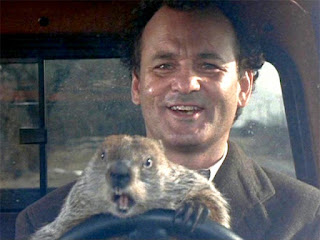
After the first event, when I hit my head, I was quite upset. It hurt really bad -- and honestly still is quite tender to the touch. Even so, the circumstances for the occurrence were completely understandable. It just happened to be that I was in the wrong place at the wrong time. Thanks to my thoughts being philosophical today, I found myself thinking, "I'll remember to avoid this occurrence 'next time around'." The idea being as if the day would repeat and I could simply avoid the mistake altogether. That shift in perspective allowed me to laugh at the silliness of the mistake and move on with my day with an added smile. Still a bump on my head, but at least not dwelling on negative thoughts.
Later, during/after some other minor similar unfortunate experiences, I kept a similar perspective. Carrying on "knowing" that I'll just do better next time. By the time I dropped the cupcake which I was very excited to eat, I had internalized that perspective and laughed aloud at the dropped cupcake. I recovered and ate what I still could, then said aloud, "OK. No hitting my head. No [makes motions with hands] while attempting to eat cupcake."
And, finally, after the diverted and delayed bus ride, I departed the bus, smiled and said, "No hitting head, no dropping cupcake, taking [alternate bus route] instead of [delayed bus route]."
I knew none of these notes would be directly applicable, as the day is unlikely to repeat as it does for Phil Connors in the film Groundhog Day [TMDB]. However, I have found this mindset to be freeing today and perhaps something I'll carry forward into the future.
As I think back on my day today and the bumps (literally) along the way, I feel lighter in mindset about the permanence of the choices and experiences we make in our one brief life. Mistakes happen; it's our reaction and recovery from those mistakes which define us, not the mistakes themselves. So, maybe, the next time I hit my head and wish I hadn't, I'll remember that I can still do better next time. And I will. As long as we keep trying, we will each do better next time.
Well, it's Groundhog Day... again.
And it's amazing to think a year has passed since my last Groundhog Day reflection. I guess after one watches a film many many times through the years, things start to blend together in memory. In fact, I find these writings have also become a review of what I've written before, if at least so I don't repeat something I've already pondered before.
This year I had a topic in mind before that alarm clock hit 06:00, but that's not what I ended up reflecting on today nor what I'm writing about now. Before I even saw the sun rising this morning, my thoughts wandered in another philosophical Groundhog Day direction.
As we all often do in our days, I had a number of things go not so well today. Of the many minor things which occurred, I'll list three events which are most prominent and useful for discussion.
The first was that I hit my head pretty hard while hurrying to catch a bus... I can still feel the bump more than 15 hours later. The second I'll mention was when I dropped a cupcake that I was looking forward to snacking on. The third and last event I'll mention was a bus ride at the end of the day that ended up being caught in traffic, having the exit for my stop closed, and therefore reaching my stop almost an hour after its scheduled time.
Each of these events were certainly unfortunate, but felt different today thanks to a small bit of Groundhog Day perspective.

After the first event, when I hit my head, I was quite upset. It hurt really bad -- and honestly still is quite tender to the touch. Even so, the circumstances for the occurrence were completely understandable. It just happened to be that I was in the wrong place at the wrong time. Thanks to my thoughts being philosophical today, I found myself thinking, "I'll remember to avoid this occurrence 'next time around'." The idea being as if the day would repeat and I could simply avoid the mistake altogether. That shift in perspective allowed me to laugh at the silliness of the mistake and move on with my day with an added smile. Still a bump on my head, but at least not dwelling on negative thoughts.
Later, during/after some other minor similar unfortunate experiences, I kept a similar perspective. Carrying on "knowing" that I'll just do better next time. By the time I dropped the cupcake which I was very excited to eat, I had internalized that perspective and laughed aloud at the dropped cupcake. I recovered and ate what I still could, then said aloud, "OK. No hitting my head. No [makes motions with hands] while attempting to eat cupcake."
And, finally, after the diverted and delayed bus ride, I departed the bus, smiled and said, "No hitting head, no dropping cupcake, taking [alternate bus route] instead of [delayed bus route]."
I knew none of these notes would be directly applicable, as the day is unlikely to repeat as it does for Phil Connors in the film Groundhog Day [TMDB]. However, I have found this mindset to be freeing today and perhaps something I'll carry forward into the future.
As I think back on my day today and the bumps (literally) along the way, I feel lighter in mindset about the permanence of the choices and experiences we make in our one brief life. Mistakes happen; it's our reaction and recovery from those mistakes which define us, not the mistakes themselves. So, maybe, the next time I hit my head and wish I hadn't, I'll remember that I can still do better next time. And I will. As long as we keep trying, we will each do better next time.
Groundhog Day 2022: Where would you like to be?
I wrote my first Groundhog Day blog fifteen years ago. Since then, I've enjoyed the intentional tradition of meditating on my various PHILosophies in life through the viewing of the 1993 film Groundhog Day [IMDB].
Usually when I choose a direction for my Groundhog Day articles, it's because some theme jumps out to me on my viewing of the film. Typically, I'll watch the film and feel drawn to a certain interpretation. I then use subsequent viewings to hone in on the theme and form my thoughts on it completely. Today was pleasantly different.
The first line of the film caught me immediately upon my initial viewing and I knew what I would write about this year:
I briefly mentioned being mindful of the present in my 2013 Groundhog Day reflection. That sense of mindfulness can help us value our actions now as we form our future. I find it important to ask myself every now and the same sort of question that Phil mentions. If the answer to that question is, "Probably right here", then I can take a moment to find contentment with the path that's led to this place in life. If the answer is to a place elsewhere in space or time, then I'll know what to adjust to get where I want to be.
I hope you're feeling happy with where you are in life or at least hopeful for the path you have ahead to get there. Take care in this year ahead, we're not through this strange "winter" just yet.
I wrote my first Groundhog Day blog fifteen years ago. Since then, I've enjoyed the intentional tradition of meditating on my various PHILosophies in life through the viewing of the 1993 film Groundhog Day [IMDB].
Usually when I choose a direction for my Groundhog Day articles, it's because some theme jumps out to me on my viewing of the film. Typically, I'll watch the film and feel drawn to a certain interpretation. I then use subsequent viewings to hone in on the theme and form my thoughts on it completely. Today was pleasantly different.
The first line of the film caught me immediately upon my initial viewing and I knew what I would write about this year:
"Somebody asked me today, 'Phil, if you could be anywhere in the world, where would you like to be?' And I said to 'em, 'Probably right here...'"Admittedly, that line continues and Phil identifies a physical location where he'd like to be, based on its current weather forecast. However, the pause after he states "Probably right here" was just long enough for me to think of the question as if regarding a state of being or place in life.
I briefly mentioned being mindful of the present in my 2013 Groundhog Day reflection. That sense of mindfulness can help us value our actions now as we form our future. I find it important to ask myself every now and the same sort of question that Phil mentions. If the answer to that question is, "Probably right here", then I can take a moment to find contentment with the path that's led to this place in life. If the answer is to a place elsewhere in space or time, then I'll know what to adjust to get where I want to be.
I hope you're feeling happy with where you are in life or at least hopeful for the path you have ahead to get there. Take care in this year ahead, we're not through this strange "winter" just yet.
connect with me:


 |
|
 |
|

|
|